EV Dyno Safety: Adapting Cells for Battery Hazards
Meta Description:
Most EV testing facilities ignore a critical reality: standard battery cells weren’t designed for dyno conditions. Thermal runaway, electrolyte leaks, and hydrogen venting can spiral from controlled test to catastrophic failure in seconds. Discover why regulatory compliance alone won’t save you, and what adaptive cell modifications actually prevent disaster.
How Thermal Runaway Threatens Chassis Dyno Safety
The danger of thermal runaway—an uncontrollable self-heating state in lithium-ion batteries—represents a critical safety concern for any facility performing electric vehicle dynamometer testing.
During chassis dyno operations, batteries endure high loads that mimic abusive conditions, potentially triggering thermal runaway in damaged or degraded cells. Temperature can spike from 100°C to 982°C in seconds, creating rapid escalation of exothermic reactions that produce toxic gases and intense heat. Electrolyte decomposition during these events releases flammable gases including ethylene, methane, and hydrogen that intensify the hazard.
Stranded energy in compromised cells risks reignition during prolonged dyno runs, while pressure build-up threatens cell rupture and gas ignition. Gas and flame ejection directly endangers operators and nearby equipment. Facilities must implement comprehensive containment protocols to protect personnel and infrastructure during high-stress battery testing scenarios.
Internal short circuits surface suddenly, demanding sophisticated fire suppression systems and containment protocols that standard dyno facilities may lack, making specialised safety infrastructure essential for EV testing operations.
Setting Chamber Temperature Limits to Prevent Battery Fire
Preventing battery fires during EV chassis dyno testing requires establishing precise chamber temperature limits that account for both ambient conditions and the vehicle’s thermal management capabilities.
Regulatory standards like ECE R100 Rev3 mandate strict operational thresholds, with manufacturers specifying maximum safe temperatures to trigger protective measures before thermal runaway initiates.
Monitoring temperature gradient rates—typically 5°C to 15°C per minute—ensures that test chambers maintain controlled heating profiles, preventing rapid temperature escalation that could compromise battery pack integrity. Advanced testing solutions like thermal chambers integrated with roller bench stands provide the infrastructure necessary to simulate diverse driving modes while maintaining safety protocols across temperature ranges from -10°C to +50°C.
Thermal Limits And Runaway Prevention
When battery systems operate within controlled temperature ranges, the risk of catastrophic thermal runaway—a chain reaction where internal heat generation accelerates beyond the cooling system’s capacity—drops dramatically.
Advanced thermal management systems, utilising liquid cooling and heat spreaders, maintain uniform temperature distribution across cells and modules. Insulation barriers, including ceramic-coated separators and fire-resistant materials like Go-Therm glass silicone laminates, prevent heat propagation between cells. Battery Management Systems continuously identify overvoltage, undervoltage, and overcurrent conditions that could trigger dangerous chemical reactions. Customisable testing scenarios allow engineers to evaluate battery performance under diverse operational demands and environmental stressors.
Battery management systems continuously monitor cell temperature, voltage, and current, detecting anomalies before they escalate. When abnormal conditions arise, these systems reduce charge or discharge rates accordingly.
Proper chamber temperature control during dynamometer testing—ideally between 2°C and 32°C—combined with certified fast-charging protocols, guarantees battery safety while maximising test reliability and operational performance.
Chamber Gradient Monitoring Protocols
Battery thermal management during electric vehicle dynamometer testing depends critically on precise chamber temperature control, as uneven heat distribution across test cells can accelerate degradation and trigger dangerous thermal runaway scenarios.
Advanced gradient monitoring systems track temperature variations across the test chamber in real time, identifying hot spots before they become hazardous.
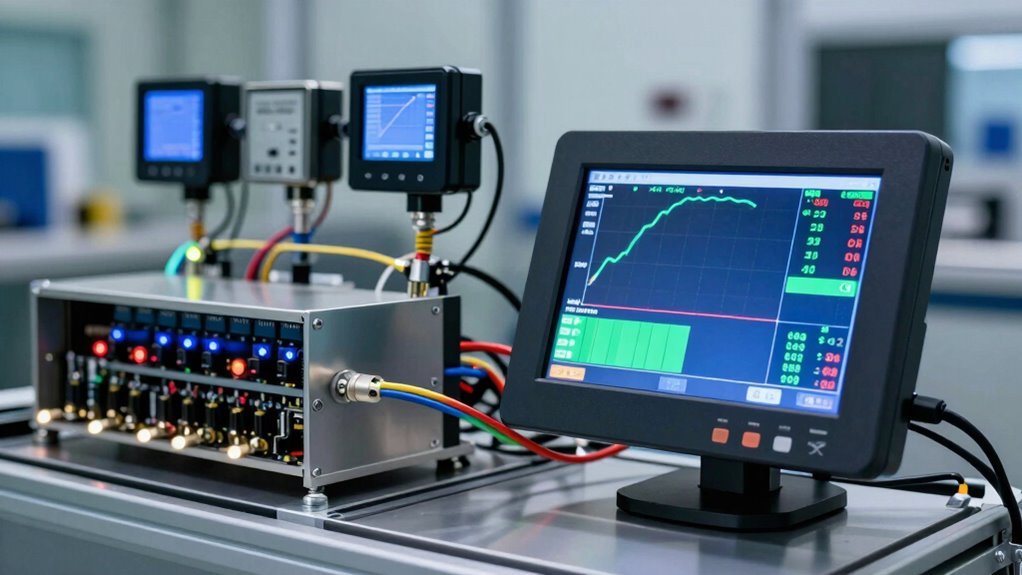
Hyper Power’s Hyperwin4 software integrates sophisticated sensor arrays that maintain stringent safety protocols by continuously measuring chamber differentials. These monitoring capabilities align with the test bench’s broader mission to validate powertrain systems and control strategies under diverse conditions while prioritising component safety.
When temperature gradients exceed safe thresholds, mechanised systems adjust cooling systems or pause testing procedures, preventing catastrophic battery failures.
Professional operators certified through Hyper Power’s training programmes comprehend how to interpret gradient data and establish appropriate temperature limits. Continuous learning resources ensure operators maintain expertise in the latest safety protocols and technological advancements in battery thermal management.
This proactive approach protects expensive battery packs while ensuring testing reliability and operator safety throughout the evaluation process.
Mechanical Shielding Standards for Dyno Battery Testing
As electric vehicles continue to dominate the automotive environment, the need for rigorous battery testing has become paramount in dynamometer facilities worldwide. Mechanical shielding standards protect testing environments from potential battery hazards during performance evaluation.
EUCAR Hazard Levels classify battery risks from Level 0 to Level 7, requiring appropriate containment based on energy capacity and composition. Chassis dynamometer enclosures employ specialised shielding materials engineered for mechanical integrity, preventing cell-to-cell propagation during thermal events or overload conditions. Our precision testing services ensure that all battery evaluation protocols meet the highest industry standards.
ISO 16750 and ISO 12405 standards specify environmental stress testing protocols that validate battery reliability under extreme temperatures and charge-discharge cycles. These structures guarantee dynamometer facilities implement proportionate safety equipment matched to battery specifications. High voltage battery test systems are fully line regenerative for energy efficiency while maintaining rigorous safety protocols during extended testing operations.
Turnkey shielding systems integrate ancillary components for thorough hazard containment, enabling engineers to perform full-scale validation safely while maintaining testing accuracy and operational confidence.
Monitoring Hydrogen Venting in Real Time: Limits and Compliance
Hydrogen gas detection during battery testing requires adherence to strict concentration thresholds, with IEEE 450 standards establishing a lower detection limit of 1000 ppm and alarm setpoints at 4000 ppm and 10000 ppm respectively.
Real-time monitoring systems must identify hydrogen release within the critical five-second window mandated by ISO 6469-6, using thermal conductivity sensors or solid-state hydrogen detectors positioned at draft-free points to guarantee accurate, continuous measurement.
Integration of these sensors with battery management systems enables immediate power-down protocols and ventilation activation, providing the rapid response necessary to prevent thermal runaway escalation in dynamometer test environments.
Hydrogen Concentration Threshold Standards
Safety in battery testing environments hinges on comprehending explosive gas thresholds, which define the limits between safe operations and dangerous accumulations.
Hydrogen’s Lower Explosive Limit (LEL) begins at 4% by volume in air, establishing the baseline for hydrogen threshold compliance. Federal standards mandate concentrations remain below 3.0%, while IEEE recommendations are more stringent, capping levels at 2% by volume to maintain critical safety margins.
The Upper Explosive Limit reaches 75%, creating a wide flammable range requiring vigilant monitoring. Regulatory structures like IFC and NFPA establish mandatory mechanical exhaust systems when hydrogen approaches specific thresholds, ensuring facilities maintain explosive limit awareness.
Peak hydrogen production occurs during 90-95% charge conditions, demanding real-time sensor integration and alarm systems triggering at 1-2% concentrations to prevent hazardous buildup in battery testing facilities.
Real-Time Detection System Requirements
Because hydrogen venting occurs continuously during EV battery testing and charging operations, real-time detection systems form the critical foundation of facility safety protocols.
Sensor integration with existing PLC and BMS infrastructure enables seamless monitoring without operational interruption.
Real-Time Monitoring Capabilities:
- Auto-calibrating sensors require no calibration gases, maintaining accuracy throughout testing cycles
- Continuous monitoring initiates ventilation automatically upon rising hydrogen levels at 1% concentration
- Metal oxide sensors detect a wide range of gases, including hydrogen and electrolyte vapours, with fast response times
- Self-diagnosing features alert operators to sensor abnormalities before they compromise safety
- Integration with control systems enables coordinated responses, such as current reduction or cooling activation
Professional facilities recognise that reliable, low-maintenance detection systems protect both equipment and personnel. Proactive system monitoring through partnerships with experienced dynamometer providers ensures comprehensive safety coverage during all testing phases.
Hydrogen sensors with 10+ year lifespans eliminate recurring calibration expenses while ensuring consistent safety performance throughout demanding EV dyno operations.
Designing REESS to Survive Post-Crash Mechanical Shock
When electric vehicles experience collision events, the rechargeable energy storage system (REESS)—commonly known as the battery pack—must withstand severe mechanical forces without rupturing, leaking, catching fire, or exploding.
Strategic Design for Battery Resilience
Modern REESS designs employ staggered cell arrays and prevent block building to minimise movement during impact, enhancing battery resilience against crash-induced forces.
Proper shock absorption requires integration concepts matched to vehicle size, battery type, and location.
Meeting Mechanical Standards
Batteries undergo conditioning for temperature and humidity before mechanical shock testing per IEC 62660-2, SAE J2464, and ECE R100 standards.
Real-time CAN datalogging monitors energy storage and battery management systems during tests, ensuring no internal short circuits, electrolyte leakage, or thermal runaway occurs in realistic high-load scenarios.
Rupture Testing and Electrolyte Containment Requirements
After confirming that a battery pack can absorb mechanical shock without internal damage, manufacturers must verify that the REESS remains sealed and leak-free even after severe abuse.
Battery packs must remain sealed and leak-free following severe mechanical abuse to prevent dangerous electrolyte exposure.
Rigorous testing protocols identify potential rupture mechanisms and prevent dangerous electrolyte leakage.
Critical Testing Methods:
- Crush tests compress batteries between plates, measuring deformation force thresholds
- Penetration tests drive sharp objects into cells, quantifying resistance to puncture damage
- Impact tests drop batteries from heights, simulating shock-induced rupture scenarios
- Vacuum chambers with helium detect microscopic leaks in seals and welds
- Discharge current methods identify holes in pouch cells through ion movement analysis
SAE J2464 standards mandate these evaluations, ensuring electrolyte containment post-abuse.
Engineers verify mechanical integrity through force measurements and tracer gas concentration monitoring at 100 ppm sensitivity levels, preventing fire hazards from hazardous electrolyte exposure.
FMVSS 305a vs. UN GTR vs. SAE J1711: Which Standard Applies?
Which regulatory structure governs EV battery safety during dynamometer testing depends entirely on the vehicle’s intended market, weight class, and testing environment.
In the United States, FMVSS 305a mandates battery safety for all electric vehicles, including heavy-duty models, establishing mandatory REESS performance standards and electrical isolation requirements of 500 ohms/volt post-crash.
UN GTR No. 13 influences international harmonisation but lacks direct US enforceability, creating standard interpretations that vary by region.
SAE J1711 provides voluntary dyno-specific guidance, addressing test cell configurations rather than regulatory compliance.
Compliance challenges emerge when facilities serve multiple markets.
Professional installation and setup services ensure dynamometer cells are configured to meet these complex regulatory requirements across different testing scenarios.
Hyper Power’s approach integrates FMVSS 305a requirements into dynamometer cell design, ensuring US-market vehicles meet mandatory standards while accommodating international testing protocols, thereby positioning clients ahead of developing regulatory environments.
Configuring Dyno Test Cells to Meet Multiple Safety Standards
Because regulatory structures differ across markets and jurisdictions, dynamometer test cells must be constructed with versatility built into their foundational design.
Dyno configuration strategies guarantee facilities remain compliant across multiple standards simultaneously.
Key Safety Compliance Measures:
- Install modular ventilation systems capable of adjusting extraction rates for different vehicle types and emission standards
- Implement dual-zone electrical systems meeting both local codes and international GFCI requirements
- Position safety switches and fuel shutoffs outside test cells for universal accessibility
- Establish barrier configurations accommodating various vehicle dimensions while maintaining operator protection
- Utilise CO detection systems with visual and audible alarms suitable for advancing battery thermal management protocols
Facilities adopting flexible safety infrastructure protect personnel effectively, reduce costly retrofits, and maintain regulatory alignment as EV testing demands progress.
This forward-thinking approach strengthens operational resilience across changing market requirements. Partnering with providers offering comprehensive technical support ensures your facility maintains compliance while scaling dynamometer capabilities across evolving testing standards.