Hysteresis Brakes: The Pros and Cons for Dynamometers
Forget everything you know about brake technology. While friction-based systems have dominated for decades, hysteresis brakes operate in an entirely different realm—using magnetic principles to eliminate wear and extend equipment life dramatically. But here’s the catch: their power management demands are ruthless, and thermal control can make or break your dynamometer’s performance. Discover why engineers are divided on whether these frictionless systems represent the future or a costly gamble.
What Are Hysteresis Brakes and How Do They Work?
Because dynamometer systems must deliver precise, repeatable braking force across a wide range of vehicle types and testing scenarios, hysteresis brakes represent a fundamental advancement in load simulation technology.
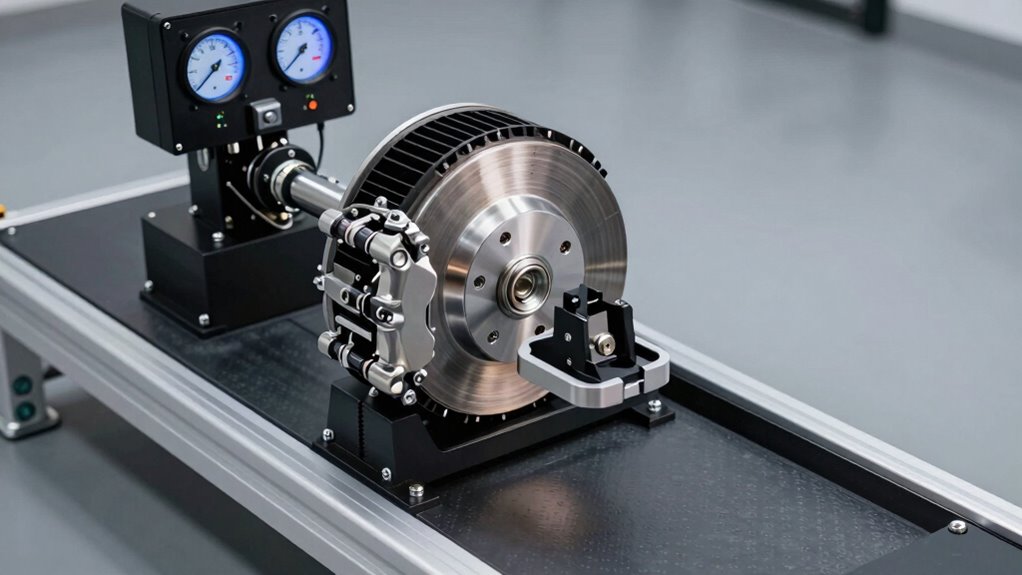
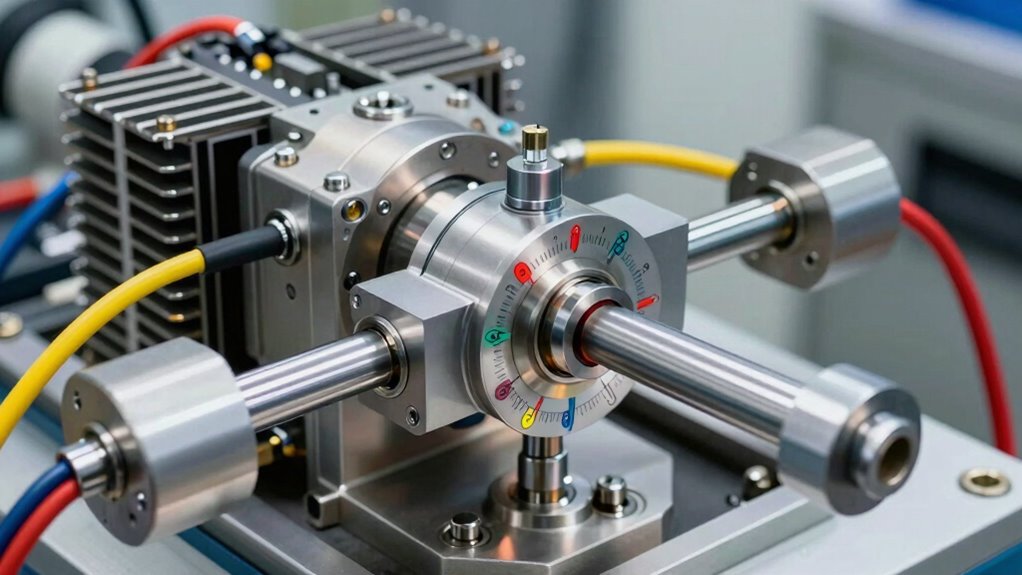
Hysteresis brakes operate through a magnetic hysteresis mechanism where a field coil generates internal magnetic flux that transfers into a rotor, inducing magnetic drag. Unlike friction-based systems, this frictionless design eliminates wear and maintenance concerns while ensuring consistent performance. Our precision testing services ensure that these systems perform optimally across all applications.
The rotor resists rotation through magnetisation, creating smooth braking action across all speed ranges, including zero RPM. Torque generation remains proportional to current flowing through the coil, allowing operators to adjust braking force precisely from minimum to 35% above rated capacity. These brakes require minimal maintenance due to their lack of mechanical contact between components.
No mechanical contact occurs between components, enabling the brake to deliver high torque repeatability without jerky effects, making hysteresis brakes ideal for demanding dynamometer applications.
Precision Control Without Speed Dependency
Unlike conventional braking systems that rely on rotational speed to generate resistance, hysteresis brakes deliver consistent torque output regardless of whether the motor is spinning at full RPM or locked in a stationary position.
This speed-independent capability enables dynamometer operators to apply precise load control from zero RPM through maximum operating speeds, eliminating gaps in testing coverage that friction-based systems cannot address.
The ability to maintain constant torque at standstill conditions, in particular, allows for thorough motor evaluation that captures performance characteristics across the complete operational envelope. With accuracy ratings of ± 0.25% full scale, operators can rely on consistent and repeatable test results for quality assurance across various testing applications. Our customisable testing scenarios ensure that each dynamometer test is tailored to meet your specific performance evaluation objectives.
Constant Torque Across All Speeds
Hysteresis braking systems deliver a fundamental advantage that distinguishes them from conventional dynamometer technologies: they generate braking torque through magnetic force rather than mechanical friction, eliminating the speed dependency that constrains traditional systems.
The magnetic flux strength in the stator creates consistent friction with the rotor independent of rotation rate. This means constant torque remains available from zero RPM to maximum operating speed, a critical distinction for thorough testing protocols. The compact size and simple operation of hysteresis brake dynamometers make them particularly well-suited for laboratories with space constraints and operators requiring minimal training. Our comprehensive parts and maintenance kits ensure your equipment remains in optimal condition throughout its lifecycle.
Operators adjust braking force by modifying the exciting current applied to the coil, not by changing speed. This direct proportionality between excitation current and torque output enables precise load adjustments with ±0.25% accuracy across the entire operating range.
The speed independence characteristic enables engineers to perform complete motor evaluations, from free-running conditions through locked-rotor scenarios, without performance compromises.
Zero RPM Load Response
The ability to maintain constant torque across all speeds establishes a foundation for detailed testing, yet the most demanding evaluation scenarios require the brake system to perform effectively at the point where conventional technologies falter: zero RPM.
Hysteresis brakes deliver independent torque response without requiring shaft movement, fundamentally altering locked-rotor and standstill testing capabilities. This torque independence stems from magnetic flux generation across the air gap, eliminating the speed-dependent limitations that constrain traditional friction-based systems.
Zero RPM Load Response Advantages:
- Full torque application possible at complete standstill conditions
- Precise load characteristics maintained without motor rotation
- Smooth slipping from free-run to locked rotor positions
- Repeatable measurements at zero speed for consistent validation
- Enables thorough engine diagnostics from startup simulation
Professionals gain the precision control necessary for demanding applications, accessing information previously unavailable through conventional dynamometer technology. Oil shear load brakes complement this capability by absorbing extreme torque at low speeds, extending the practical range of zero RPM testing across diverse industrial equipment and lifecycle validation scenarios.
Why Hysteresis Brakes Require Minimal Maintenance
The fundamental advantage of hysteresis brake technology lies in its frictionless operation, where magnetic field interaction generates torque without any physical contact between moving components.
Because no friction surfaces wear down during normal operation, users avoid the repetitive replacement cycles that characterise traditional friction and magnetic particle brake systems.
This non-wear design translates directly into extended service life and greatly reduced maintenance costs, making hysteresis brakes an economically practical choice for high-duty dynamometer applications. Hyper Power’s proactive system monitoring ensures that your hysteresis brake system maintains optimal performance throughout its extended service life. Additionally, cogging torque, which is caused by residual polarisation of the rotor material, is not a defect but rather an inherent characteristic of hysteresis technology that can be minimised through proper operational procedures.
Frictionless Design Eliminates Wear
Unlike traditional friction-based brakes that rely on physical contact between surfaces, hysteresis brakes operate through a magnetic field interaction that produces braking torque without any mechanical engagement.
This wear-free operation fundamentally alters maintenance efficiency for dynamometer operators. The absence of friction eliminates several critical degradation pathways:
- No friction surfaces wear down, eliminating routine replacement cycles
- Wear debris never accumulates within brake systems, preventing contamination
- Friction coefficient fluctuations that cause inconsistent performance are entirely absent
- Stick-slip effects characteristic of traditional brakes disappear completely
- Particle aging and seal leakage associated with magnetic particle devices do not occur
Because hysteresis brakes generate torque through magnetic hysteresis rather than mechanical contact, bearing components experience considerably reduced stress.
This design philosophy delivers consistent performance throughout the brake’s operational lifespan, reducing unplanned downtime and extending service intervals considerably.
Extended Service Life Benefits
Because hysteresis brakes eliminate the friction and mechanical contact inherent in traditional braking systems, they deliver substantially extended operational lifespans that dramatically reduce maintenance demands on dynamometer operators.
The sealed magnetic design prevents contamination from internal material breakdown, eliminating particle accumulation that typically requires frequent servicing.
Without friction-generated wear, components maintain their integrity across countless testing cycles, supporting extended lifespan performance that far exceeds traditional alternatives.
This extended operational efficiency translates directly into lower total cost of ownership.
Replacement intervals stretch considerably longer, minimising downtime and unplanned maintenance events.
Operators benefit from consistent, reliable performance throughout the brake’s service life, allowing workshops to maximise their investment while focusing resources on core testing operations rather than equipment maintenance.
The tailored solutions available for specific dynamometer models further enhance maintenance efficiency by ensuring optimal compatibility and performance across different system configurations.
Power Limitations You Need to Know
Operating a hysteresis dynamometer effectively requires grasping its inherent power constraints, which directly impact equipment longevity and test reliability. Comprehending these limitations guarantees safe operation and prevents costly damage.
Understanding hysteresis dynamometer power constraints ensures safe operation, equipment longevity, and reliable test results.
Critical Power Constraints:
- Rated slip power exceeded causes overheating and device damage, requiring strict adherence to specifications.
- Maximum speed-torque combinations defined by kinetic power curves, limiting peak performance windows.
- Continuous power ratings acceptable for up to 4 hours, with coil and bearing temperatures limited to 100°C.
- Power absorption curves define maximum heat dissipation over time, preventing thermal failure.
- Transient and steady-state power dissipation critical for performance, distinguishing between peak and sustained output.
Professionals must match their testing requirements against these power ratings to maintain equipment integrity and achieve repeatable, scientifically valid results consistently. Regular software updates enhance your dynamometer’s performance and ensure optimal compatibility with your specific testing parameters.
Managing Heat in Continuous Operation
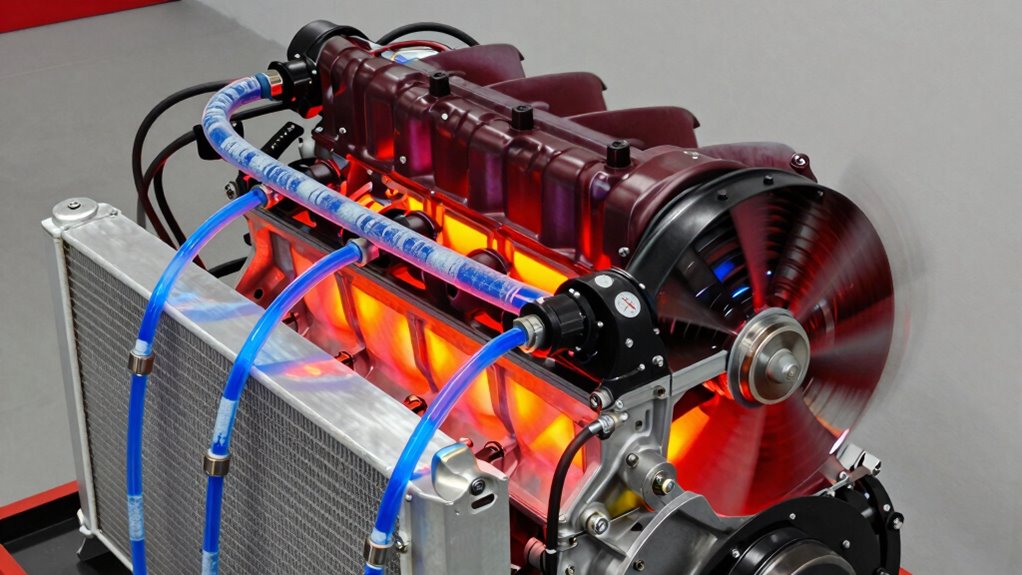
When mechanical energy converts to thermal energy through continuous slip in a hysteresis brake, the surface temperature rises rapidly and demands careful heat monitoring to prevent equipment damage. Operators must track coil and bearing temperatures, relaxing torque loads whenever readings approach the critical 100°C threshold.
Thermal Management Strategy
| Operating Condition |
Temperature Range |
Heat Dissipation Method |
Continuous Duration |
| Standard Operation |
30°C ambient |
Natural air gap cooling |
Unlimited |
| Improved Cooling |
30°C ambient |
Compressed air up to 95 PSI |
Extended performance |
| High-Stress Testing |
Near 100°C limit |
Full torque with monitoring |
24-hour maximum |
| Post-Operation |
Any temperature |
100 RPM cooldown run |
1 minute minimum |
Proper thermal management guarantees reliable performance and extends equipment lifespan. Our expert calibration techniques during system setup ensure optimal heat dissipation configurations from the start. Ventilation positioning and mounting configuration greatly influence actual heat dissipation, varying results by approximately ±50%. Maintaining ambient temperatures between -15°C and +40°C supports best brake function throughout extended testing sessions.
Best Applications for Hysteresis Brake Technology
The versatility of hysteresis brake technology extends across industries where precise torque measurement and controlled loading are essential requirements.
These systems excel in applications demanding accuracy and reliability across diverse testing scenarios.
Ideal Use Cases for Hysteresis Brake Applications:
- Automotive testing of electric and hybrid powertrains, where instant load response validates drivetrain efficiency
- Motor performance validation for consumer electronics, from robotic devices to drone propellers
- Renewable energy systems, including wind turbine generators requiring long-term reliability assessment
- Aerospace components, such as actuators and landing gear subjected to extreme operational demands
- Industrial motor certification, ensuring precise torque control independent of shaft speed
These applications benefit from hysteresis brakes’ non-contact operation, which minimises vibration and delivers torque accuracy ranging from ±0.1% to ±0.5% full scale.
The technology’s ability to maintain stable measurements across wide RPM ranges makes it essential for thorough performance evaluation.
Real-time performance evaluations enhance testing outcomes by providing immediate feedback on system behaviour under dynamic load conditions.
Hysteresis Brakes vs. Alternative Technologies: How to Choose
How does one determine which braking technology best serves a specific dynamometer application? The answer depends on operational requirements and testing priorities.
Hysteresis brake applications excel in precision environments demanding speed-independent torque control. Unlike eddy current brakes, which generate forces proportional to RPM, hysteresis brakes deliver consistent loading from zero RPM upward. This capability makes them superior for low-speed torque testing methods requiring repeatability.
Friction brakes introduce mechanical wear and torque ripple, compromising accuracy. Hysteresis technology eliminates these variables through non-contact magnetic resistance, achieving ±0.25% accuracy ratings.
However, power limitations matter. Hysteresis brakes handle up to 14 kW intermittent duty, while eddy current alternatives manage higher continuous power at increased speeds.
Selection hinges on balancing precision needs, speed requirements, and maintenance tolerance. Facilities prioritising accuracy and minimal maintenance favour hysteresis systems for their engineering advantages. Continuous professional development through proper training ensures operators maximise the benefits of their selected braking technology.