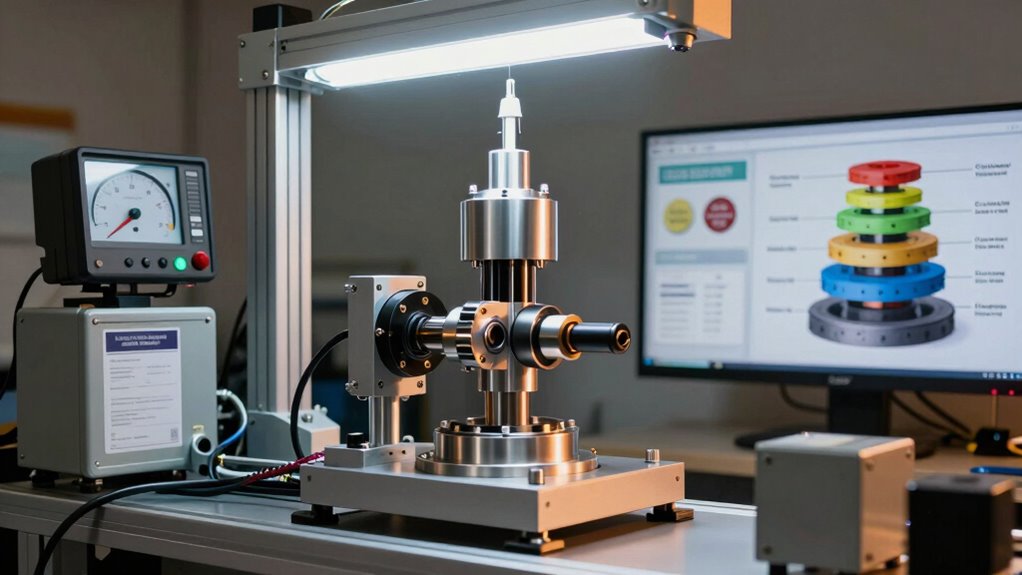
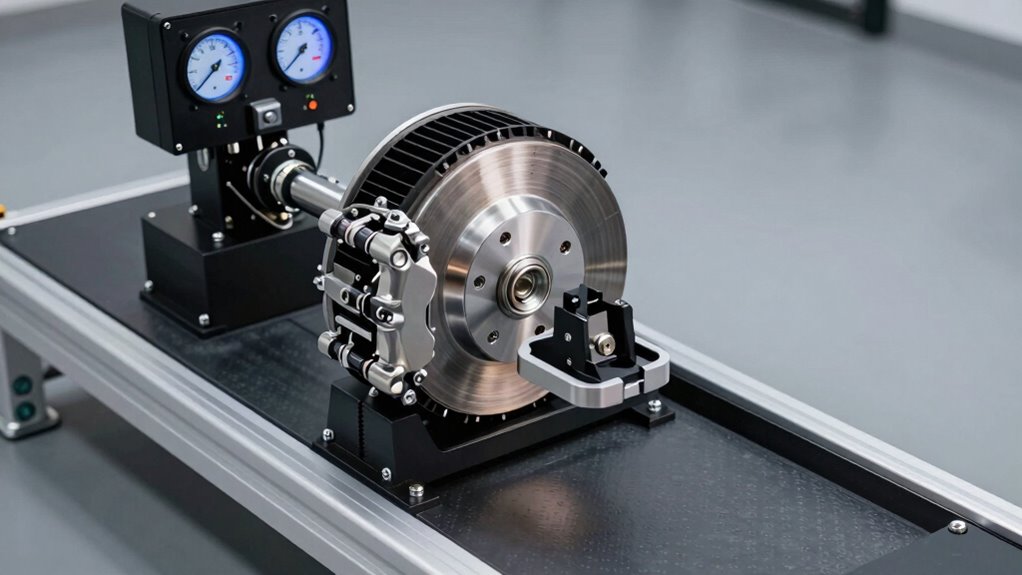
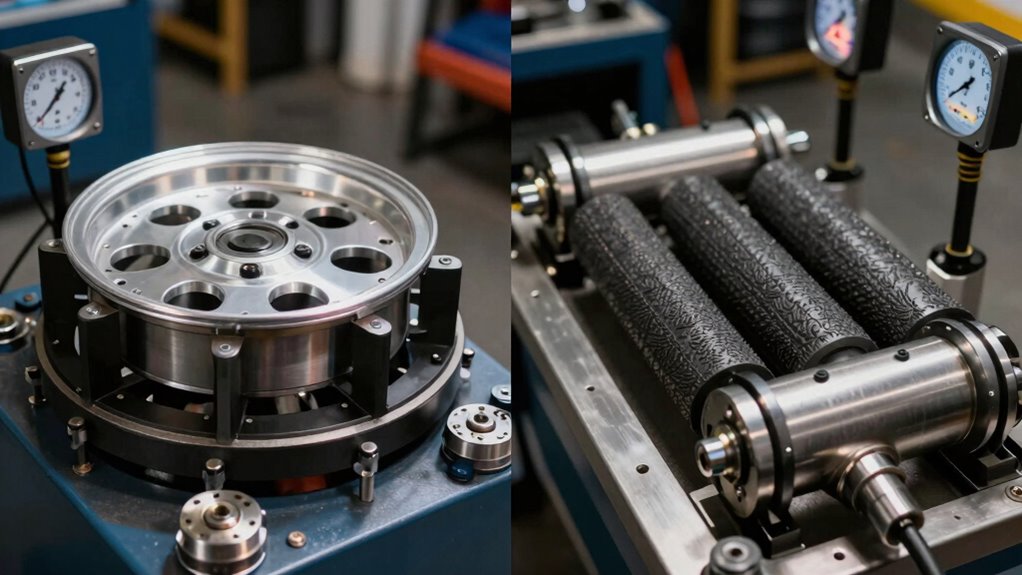
Electric vehicle dynos aren’t created equal—and most manufacturers are testing with equipment that doesn’t match their ambitions. While competitors settle for basic torque measurements, industry leaders demand systems that handle multi-motor complexity, capture ripple across extreme power ranges, and deliver real-time precision that actually matters. The gap between passing regulatory checks and dominating market expectations isn’t subtle. Discover what five critical features separate adequate testing from the systems that fundamentally change how vehicles perform.
Why Multi-Motor Testing Demands Precision Power Control
When electric vehicles integrate multiple motors—traction units, auxiliary drives, and integrated powertrains—the testing environment becomes exponentially more complex than traditional single-motor diagnostics.
Simultaneous measurement of DC current and voltage between battery and inverter, plus three-phase AC signals between inverter and motor, demands precision instrumentation that captures synchronised data across all domains. Galvanically isolated probes prevent ground loops and electrical noise that would otherwise corrupt measurements across voltage boundaries.
Safety protocols governing high-voltage and low-voltage interactions require rigorous functional testing per ISO 26262, including hazard analysis and fault injection simulations. Our cutting-edge software solutions enable comprehensive verification of these complex safety requirements.
Overcurrent protection, cross-domain short circuits, and battery-management events must be verified across operating ranges.
Accurate power analysers with advanced mathematical computations enable MTPA testing and torque-speed measurement conversion.
This synchronised approach guarantees repeatable, auditable results that satisfy certification requirements while protecting equipment and personnel throughout the testing process.
Handling 300kW to 1000kW: Power Ranges That Scale With Your Test
Electric powertrains operating across the 300kW to 1000kW range represent the practical ceiling for most automotive and light industrial applications, yet each power tier demands distinctly different dynamometer designs and control strategies.
The scaling progression guarantees operators find purpose-built solutions:
- 300kW models deliver 836Nm torque with constant power from 4000-10000rpm, supporting entry-level electric vehicle testing.
- 600kW systems absorb up to 500kW sustained load, reaching 4750Nm maximum torque for mid-range powertrains.
- 1000kW capabilities extend to 1200kW fast testing, utilising precision measuring shafts for accurate power absorption.
- Advanced load scaling accommodates emerging battery-electric and hybrid configurations, guaranteeing measurement accuracy within ±2%.
This modular approach allows testing facilities to match dynamometer capacity directly to their electric powertrain specifications. Our commitment to continuous innovation ensures these systems incorporate the latest technological advancements for superior performance measurement.
Air-cooled eddy current designs eliminate external cooling complexity, while integrated DAQ channels provide seamless data collection across all power ranges. Focus Applied Technologies specialises in developing dynamometer solutions for alternative fuels and electric powertrain research applications.
Torque Measurement: From Cogging Ripple to 32,000Nm
Precise torque measurement forms the foundation of any credible electric powertrain test, yet the challenge intensifies as motors produce increasingly complex torque signatures that older measurement methods simply cannot capture.
Modern electric motors exhibit cogging effects and torque fluctuations that demand specialised sensor technology and high-frequency data logging.
Capturing Complex Signatures
Digital torque transducers and load cell systems measure forces with precision up to 23,000rpm, while logging rates of 100-500Hz capture cogging ripple accurately. Integration with vehicle data acquisition systems enables 10 samples per second recording capability to complement transducer measurements for comprehensive powertrain analysis.
These sensors provide electrical signals proportional to actual torque, eliminating guesswork from current-draw estimates. Our state-of-the-art testing facilities maintain focus on quality control and precision throughout the testing process.
Scaling Beyond Limits
Heavy-duty testing systems reach 32,000Nm equivalent capacity, accommodating the most demanding electric powertrains.
Hyper Power’s advanced sensor integration guarantees repeatability and scientific validity across all test conditions, supplying the credible data professionals require for innovation.
Single Motors to All-Wheel Drive: Flexible Test Configurations
The diversity of electric powertrain designs demands equally diverse testing approaches, from compact single-motor setups to complex all-wheel-drive systems with multiple independent units.
Hyper Power’s modular structure delivers the test flexibility professionals need:
- Single-motor configurations using passive dynos for straightforward, cost-effective validation
- Dual-motor test stands simulating wheel loading with precision control
- Four-wheel systems handling interconnected axles across EV platforms
- Software-driven switching between steady-state and transient profiles without recalibration
Motor compatibility remains central to this versatility. Our tailored software solutions ensure seamless integration with your specific testing requirements, enhancing both capability and precision.
Independent axle setups enable targeted two-wheel testing, while AC dynamometers support full powertrain motoring simulations. AC absorbers can regenerate energy back to the grid, enhancing efficiency during extended testing cycles.
Modular battery emulation scales seamlessly, paralleling units for high-power requirements up to 100 kW per module.
This configurational flexibility guarantees that whether testing skateboard chassis or traditional structures, engineers access industrial-grade capability customised to their specific development needs.
1MHz Response Time: Why Speed Matters for Repeatable Results
When testing modern electric powertrains, the speed at which a dynamometer system responds to changing conditions directly determines the accuracy and repeatability of test results.
Ultra-fast 1MHz control cycles reduce dead times, enabling execution of highly variable test cases such as acceleration simulations. Traditional systems using phase lock loop technology require settling times in seconds, missing critical transient data.
Real-time digital signal processors execute equations on a half-cycle basis, allowing immediate power response as current emerges. This responsive capability proves essential because EV motors operate at frequencies constantly changing during acceleration and braking. Advanced systems utilise cycle detect algorithms to filter phase current, identify zero crossings, and calculate RMS values dynamically throughout variable operating conditions.
Systems capable of continuous adjustment calculate RMS voltage, current, power, and efficiency accurately throughout variable operating conditions. These real-time performance evaluations ensure that dynamometer testing delivers the precision and consistency required for modern electric vehicle development.
Faster response times minimise torque ripple and improve measurement accuracy during transients, providing the repeatable, scientifically valid data professionals demand.