Your EV’s torque readings might be misleading you. While manufacturers rely on estimation algorithms and sealed motor designs to report performance data, the gap between what your dashboard shows and actual output could be costing you efficiency and reliability.
Traditional diagnostic tools were never designed for electric motors, leaving critical blind spots in real-world performance measurement. Discover what’s hiding in your powertrain’s data.
Challenge 1: Why Traditional Analysers Fail at 5000+ RPM
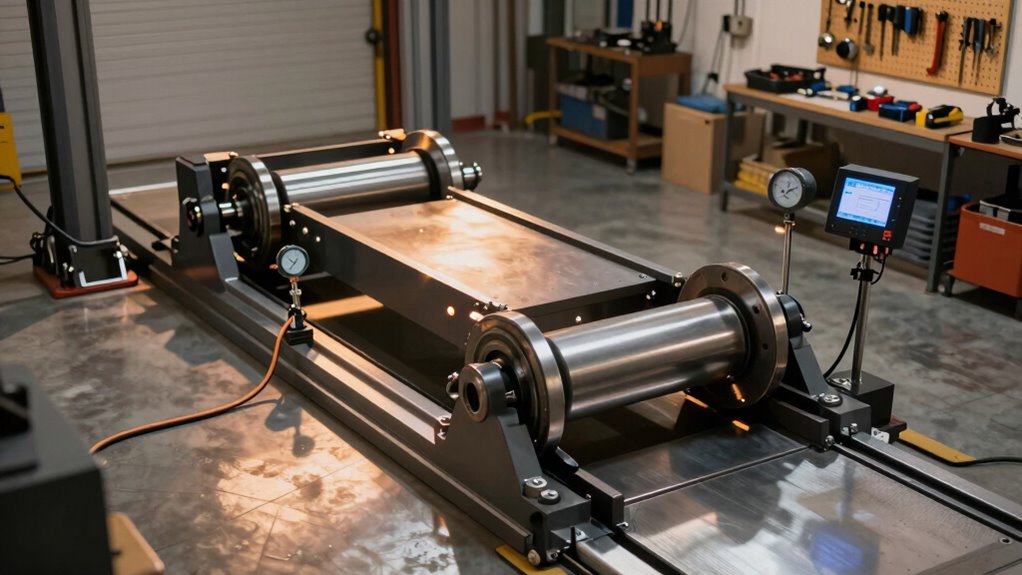
The change from internal combustion engine testing to electric vehicle diagnostics requires a fundamental shift in measurement methodology, yet many established dynamometer systems remain designed around the operational characteristics of conventional powertrains.
Traditional analysers encounter critical sensor limitations when operating above 5,000 RPM, where electromagnetic interference intensifies and power loss accelerates dramatically. These systems struggle with accurate voltage and torque measurement simultaneously, compromising data reliability. Our dynamometer technology advances address these limitations with precision engineering.
RPM challenges compound this problem greatly. Windage losses escalate with RPM cubed—10W at 3,000 RPM becomes 270W at 9,000 RPM—overwhelming conventional sensor arrays. At extreme speeds, centrifugal force can cause embedded magnets to break through electrical steels, creating additional measurement instability.
Moreover, sensorless operation reduces maximum torque per amp, further degrading efficiency calculations at heightened speeds.
Modern EV motors routinely exceed these thresholds. Tesla Model 3 motors reach 16,000 RPM, while Model S Plaid variants approach 20,000 RPM.
Legacy dynamometer infrastructure simply cannot track these performance envelopes with clinical accuracy, leaving tuning professionals without reliable data for optimisation.
Challenge 2: Testing EV Motors You Can’t Physically Access
Because electric vehicle motors are sealed units integrated directly into vehicle design, traditional dynamometer testing methods that rely on physical sensor connections often prove impractical or impossible.
Remote diagnostics and non-invasive testing technologies address this critical limitation.
Infrared thermal imaging captures temperature distribution across motor components without contact, eliminating measurement uncertainties from wired connections.
Magnetic field sensing characterises motor condition during operation by detecting electromagnetic emissions, while acoustic analysis monitors sound signatures for thorough diagnostics.
When direct access proves impossible, megger testing provides rapid insulation screening through DC voltage measurement.
Surge testing applies high-voltage impulses to detect turn-to-turn insulation degradation invisible to resistance-based approaches. Partial discharge testing identifies early-stage insulation degradation through sensitive monitoring of electrical discharges within sealed motor assemblies.
These non-invasive methods simplify testing workflows, enabling professionals to assess motor integrity regardless of physical accessibility constraints, while maintaining the precision and reliability expected in comprehensive performance analysis.
Challenge 3: Replacing Estimation With Real Torque Data
While traditional EV motor testing often relies on mathematical estimation algorithms to calculate torque values, direct measurement technologies now offer superior accuracy and reliability for performance validation.
Torque estimation methods, particularly in IPMSM systems, depend on flux estimators and efficiency calculations that introduce significant error margins. These indirect approaches average estimation errors within 1 Nm at moderate speeds, yet inverter non-idealities further degrade accuracy.
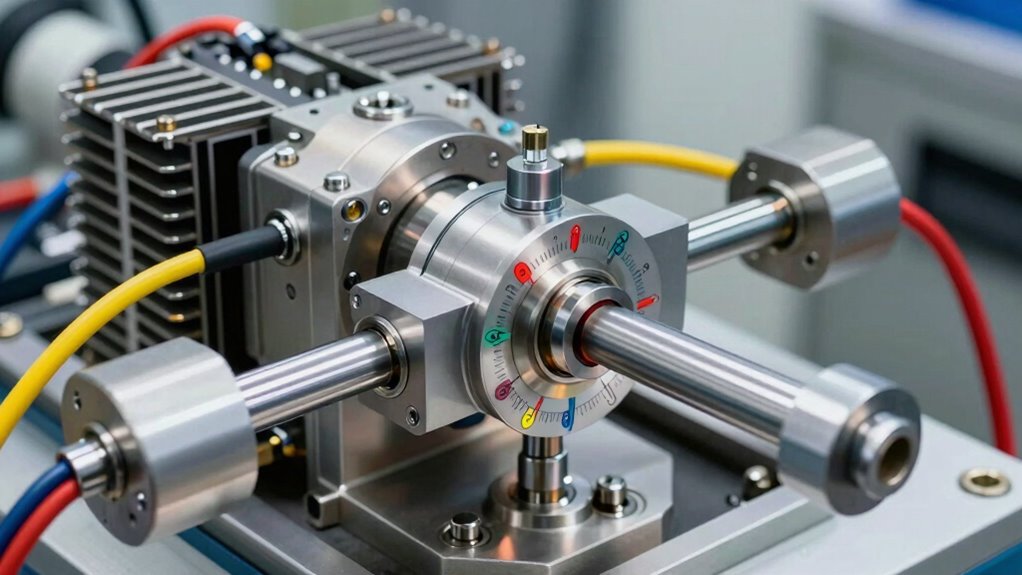
Direct measurement technologies eliminate these limitations entirely. Shaft-mounted sensors and strain gauges provide real-time torque data with precision exceeding ±1% accuracy. Surface Acoustic Wave sensors achieve this measurement accuracy through wireless, passive, non-contact operation, eliminating the need for external power sources on the shaft. These innovative add-ons support advanced testing methods that expand the utility of existing dynamometer systems.
Reaction torque sensors positioned between motor and brake deliver clinically precise measurements, enabling engineers to validate motor performance without computational uncertainty. This direct measurement capability converts EV development, replacing approximations with concrete data that drives genuine innovation and confidence in motor reliability across demanding applications.