Meta Description:
Most heavy industry manufacturers still rely on outdated testing methods—and it’s costing them millions. Hydraulic dynamometers reveal performance truths that conventional approaches miss entirely, preventing catastrophic field failures before they happen. Your equipment’s real capacity isn’t what you think it is.
What Hydraulic Dynos Do and Why You Need Them
Load testing—the process of measuring how machinery performs under real-world stress—forms the backbone of industrial reliability and safety.
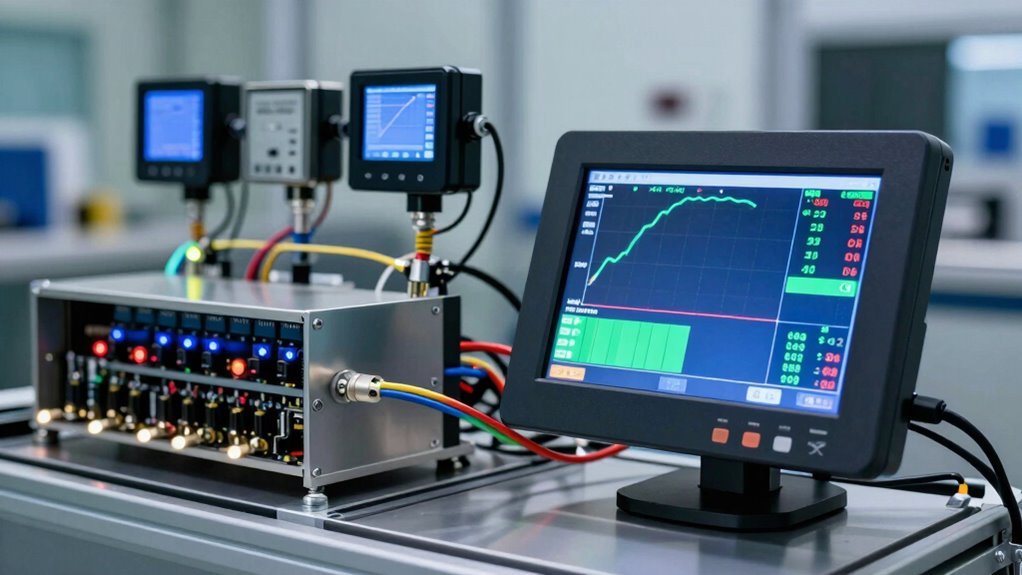
Hydraulic dynamometers apply load through fluid resistance, absorbing power via viscous shear between rotor and stator elements. This contactless method enables precise torque and speed control without mechanical wear, ensuring testing accuracy across variable conditions.
Hydraulic dynamometers deliver precise torque and speed control through fluid resistance, eliminating mechanical wear while ensuring testing accuracy across variable conditions.
Heavy industry relies on this technology to verify motor, pump, and compressor performance after repair or rebuild. Military applications have demonstrated that containerised testing units can be rapidly deployed to remote locations for equipment validation, establishing best practices now adopted across industrial sectors.
Hydraulic efficiency remains consistent whether testing conveyor systems, crushers, or blowers under extreme mining conditions. Closed-loop computer controls adjust fluid flow automatically, producing repeatable measurements of torque, power, and drivetrain efficiency. Our advanced testing methodologies ensure that all measurements meet the highest standards of precision and reliability.
Businesses gain early detection of performance issues in HVAC systems, wastewater equipment, and industrial machinery, preventing costly failures and workplace injuries before equipment utilisation.
Automotive Engine Testing and Powertrain Validation
While hydraulic dynos excel at verifying industrial machinery across mining, manufacturing, and facility operations, their application in automotive engineering demands a more polished focus on powertrain performance and engine integrity.
Hydraulic dynamometers validate entire powertrains by testing transmissions, torque converters, and hydraulic systems under controlled, repeatable conditions. Engineers use these systems for engine calibration, adjusting fuel curves and ignition timing with instant feedback under load. The force transducer measures the rotational strength generated during these calibration sessions to ensure precision. Our cutting-edge software solutions provide real-time data analysis and performance tracking throughout the calibration process.
Performance optimisation occurs through loaded step tests at stabilised RPM points, enabling accurate comparisons between engine and chassis dyno results. The technology replaces costly road testing, eliminating time delays and safety risks.
Mining and Construction Equipment Under Load
Excavators, drills, and heavy construction machinery operate under extreme pressures and temperatures that demand rigorous performance validation before utilisation.
Hydraulic dynamometers simulate these demanding real-world conditions, testing equipment torque, speed, and load absorption capabilities to verify machinery meets manufacturer specifications and industry standards. Advanced hydraulic dynamometers use fluid resistance to measure power output by absorbing energy generated during equipment operation. Our precision testing services ensure that equipment validation meets the highest performance standards required for heavy industrial applications.
This testing approach guarantees equipment reliability in harsh environments, reduces costly downtime from equipment failure, and confirms operational safety across mining and construction job sites.
Modern construction and mining operations depend on precise measurement systems to validate equipment performance under demanding conditions. Excavator load testing establishes critical performance baselines through systematic evaluation of hydraulic systems under real-world scenarios.
Key performance validation methods include:
- Strain gauge installation on hydraulic cylinder piston rods captures accurate force response during excavation operations.
- Boom and bucket hydraulic cylinders tested individually to isolate load variables and obtain precise force data.
- Pressure transmitters track cylinder pressures while draw-wire sensors measure bucket position, correlating load forces with operational conditions.
Real-time data evaluation reduces processing time from 1-2 days to single-test completion, enabling faster capacity determination. Measurement positions including Over Blade with Blade Down, Over Blade with Blade Up, and Over Side with Blade Up ensure comprehensive load assessment across all critical operational angles. Advanced integration capabilities enable seamless coordination between measurement systems for enhanced testing precision.
Function limit identification through dual logic detection confirms maximum force values by tracking sustained pressure changes across multiple samples.
This thorough approach guarantees equipment reliability and operator safety in demanding mining and construction environments.
Durability Validation In Harsh Conditions
The rigorous load testing methods used to evaluate excavator hydraulic systems form the foundation for understanding equipment performance, yet real-world mining and construction operations demand a deeper validation approach that extends beyond single-point measurements.
Durability testing applies sinusoidal, cyclic, and random load inputs to simulate actual working conditions, determining expected product life under extreme stress. This thorough validation identifies potential failures before equipment implementation, protecting operators from costly downtime in harsh environments. Since life cycle costs can be 2-3 times higher than initial purchase price, comprehensive durability testing becomes essential for minimising long-term operating expenses. Real-time performance evaluations during durability testing enhance the reliability of failure predictions and optimise testing outcomes.
Hydraulic seal optimisation through advanced material selection and profile design extends excavator service life to 15,000+ hours, doubling original equipment manufacturer lifespans.
Equipment lifespan improvement becomes achievable when testing protocols account for actual workload intensity and environmental factors specific to mining operations. Strategic improvement planning based on advanced data interpretation ensures that durability validation captures the complexity of real-world conditions.
Strategic durability validation guarantees heavy machinery performs reliably when performance matters most.
Safety Assurance For Heavy Equipment
Every piece of mining and construction equipment operating under load carries inherent risks that demand rigorous validation before utilisation in the field. Hydraulic dynamometers enable operators to verify equipment performance safely, away from production environments, guaranteeing compliance with OSHA and ASME standards.
Critical Safety Protocols:
- Proof load testing at 125% of rated capacity annually validates structural integrity and prevents catastrophic failures in demanding applications.
- Calibrated load indicators and verified measurements guarantee accurate data collection, building confidence in equipment reliability across harsh job sites.
- Thorough equipment inspections before operation identify potential weaknesses, protecting personnel and maximising operational uptime.
Gradual load increments reveal performance thresholds, while detailed test documentation maintains transparent records. Advanced diagnostic tools from qualified support partners can identify hidden structural issues before they become safety liabilities in field operations.
This systematic approach to safety protocols and equipment inspections changes validation from regulatory requirement into competitive advantage, enabling operations with assured reliability and peace of mind.
Marine and Maritime Propulsion Systems
Propulsion in maritime vessels represents a complex engineering domain where diesel engines, electric motors, gas turbines, and hybrid systems work in concert to move everything from cargo ships to naval frigates across the world’s oceans. Modern marine propulsion systems demand precision testing to guarantee reliability, efficiency, and compliance with international standards. Professionals working in this field can enhance their expertise through dynamometer technology certification to ensure accurate performance validation across diverse marine applications.
| Propulsion Type |
Primary Application |
Key Advantage |
Speed Range |
| Slow-speed diesel |
Large cargo ships |
54% efficiency, direct coupling |
<200 rpm |
| Medium-speed diesel |
Frigates, generators |
Balanced power output |
200-1000 rpm |
| Diesel-electric hybrid |
Naval vessels |
Improved manoeuvrability |
Variable |
| Gas turbine systems |
High-speed naval craft |
Rapid acceleration |
>1000 rpm |
Hydraulic dynamometers play a critical role in validating marine propulsion performance, measuring torque and power output under controlled conditions, confirming vessels meet operational specifications before implementation.
Understanding Dyno Specifications: Power, Torque, Speed, and Type
Heavy industrial applications demand dynamometers engineered to handle extreme operational parameters, with power ratings, torque capacity, and maximum speed specifications serving as critical selection criteria.
Comprehending how these three performance metrics interact enables engineers and facility managers to match equipment capabilities with specific testing requirements, whether evaluating massive diesel engines, marine propulsion systems, or complex drivetrain assemblies.
The interplay between absorbing power (measured in kilowatts), rotational force (measured in Newton-metres), and operational speed (measured in RPM) fundamentally determines whether a dynamometer can safely and accurately test a given industrial application.
Selecting appropriate accessories and parts ensures optimal performance and extends the functionality of dynamometer systems in demanding heavy industrial environments.
Power And Speed Ratings
The foundation of dynamometer selection rests on comprehending how power, speed, torque, and equipment type interact to meet specific testing demands. Standard hydraulic dynamometer power ratings extend from 400 kW to 25,000 kW, accommodating diverse industrial applications.
Speed capabilities demonstrate an inverse relationship with power output. Consider these critical specifications:
- DT700-1 units achieve 7,500 rpm while maintaining 700 kW capacity
- DT3600-1 models operate at 3,000 rpm with 3,600 kW output
- Froude F type dynamometers support speeds reaching 10,000 rpm across their range
This speed-to-power balance guarantees operators select equipment matching their testing protocols.
Professionals recognise that matching power ratings and speed capabilities directly impacts measurement accuracy and operational efficiency, establishing reliability within heavy industrial testing environments. Partnering with installation specialists who employ expert calibration techniques ensures your dynamometer system delivers precision from initial setup through ongoing operation.
Torque Capacity Requirements
While power and speed ratings establish the operational envelope for dynamometer selection, torque capacity determines whether a unit can safely absorb and measure the rotational forces generated by an engine or motor under test.
Heavy industry applications demand dynamometers engineered for extreme torque measurement, ranging from 1,000 Nm in standard models to 35,000 Nm in specialised configurations.
Proper torque calibration guarantees measurement accuracy within 0.2% of full-scale deflection, critical for diesel engines, marine powerplants, and industrial turbines.
Advanced hydraulic designs featuring viscous shear elements and self-centring polygon connections minimise measurement error while preventing shaft failure.
Regular software updates enhance measurement precision and ensure your dynamometer maintains optimal performance standards across evolving testing requirements.
Comprehending your application’s peak torque requirements prevents costly equipment oversizing or dangerous undersizing, guaranteeing reliable performance across demanding industrial testing scenarios.
Renewable Energy and Turbine Testing
How can manufacturers guarantee that wind turbine components perform reliably under extreme conditions before application in the field? Hydraulic dynamometers provide the answer, enabling thorough testing of drivetrain systems and gearboxes under simulated real-world stress.
These systems replicate the complex loads and variable speeds that turbines experience, ensuring wind turbine efficiency optimisation before costly field implementation.
Advanced hydraulic dynos deliver critical capabilities:
- Months of continuous endurance testing without weather delays, compressing timelines considerably
- Transverse shaft load simulation using hydraulic actuators, identifying potential failures early
- Hydraulic energy recovery systems that reduce facility costs while supporting sustainability goals
Water brake and regenerative technologies test turbines up to 10,000 horsepower, confirming design benefits.
Industry leaders including Vestas and Siemens Gamesa rely on these solutions for performance validation and efficiency gains.
Matching Dyno Capacity and Configuration to Your Operation
Selecting the right hydraulic dynamometer requires careful alignment between equipment specifications and operational demands, since undersized systems compromise testing accuracy while oversized units waste capital and facility resources.
Proper dynamometer sizing aligns equipment specifications with operational demands, preventing testing inaccuracy and resource waste.
Assessing Power Requirements****
Hydraulic dynamometers range from 50 HP to 15,000 HP, accommodating diverse industrial applications. The DT series extends from 400 kW to 12,600 kW for heavy-duty operations.
Water brake dynos handle 350 to 10,000 HP, ideal for high-power diesel testing. Proper dyno configuration guarantees operational efficiency by matching system capacity to actual workload specifications.
Evaluating Torque and RPM Capacity****
The I-Series provides maximum torque at low RPM, with ranges from 0-3,600 for diesel engines.
Prony brake designs maintain stable torque and RPM setpoints with moderate ramp rates, providing precise control critical for heavy industry jobs requiring repeatable, accurate measurements.