Meta Description:
Most drivers install hub adapters without realising one critical mistake ruins everything. Your bolt pattern, pitch circle diameter, and hub bore aren’t interchangeable—get even one wrong and you’re facing vibration, misalignment, or catastrophic wheel failure. Hub-centric versus lug-centric designs demand precision most people overlook. The adapter thickness and mounting style you choose directly determines whether your wheels survive the next 10,000 miles. Learn which specifications actually matter before your next wheel swap.
What Hub Adapters Do and Why You Need One
Hub connectors serve as intermediary components that bridge the gap between a vehicle’s factory hub and aftermarket wheels, enabling drivers to install wheels designed for different bolt patterns without requiring extensive mechanical modifications.
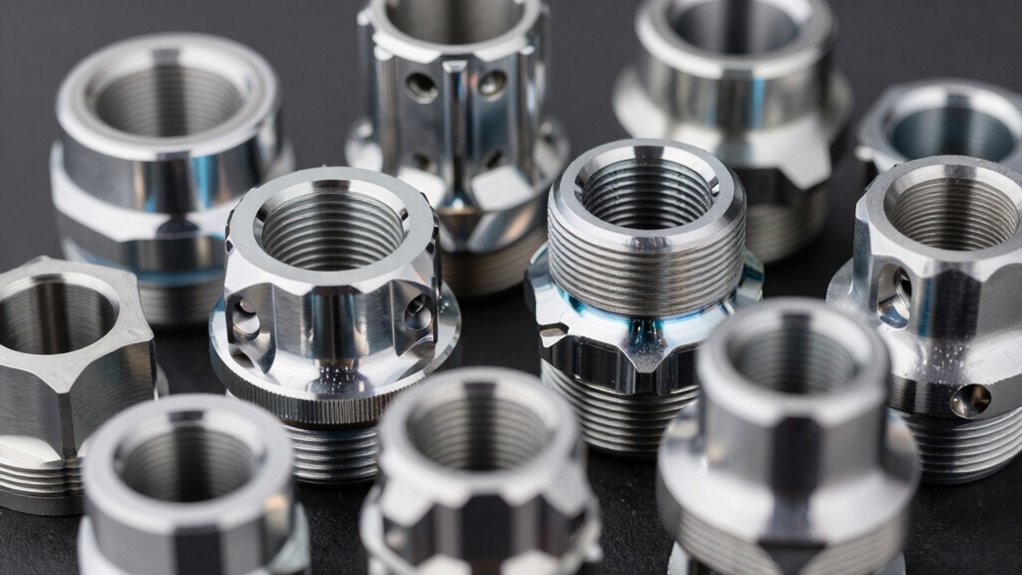
These metal discs bolt directly onto existing wheel hubs, altering bolt patterns to match desired wheel specifications.
Understanding hub adapter benefits clarifies their essential role in vehicle customisation. They adjust wheel offset, modify centre bore diameter, and convert lug-centric wheels into hub-centric configurations that reduce high-speed vibration. Hub-centric adapters fill gaps between the axle and hub to ensure a snug fit and proper wheel fastening.
Hub adapters adjust wheel offset, modify centre bore diameter, and convert lug-centric wheels into hub-centric configurations that reduce high-speed vibration.
This flexibility expands wheel options markedly, allowing unique aesthetic appearances without structural modifications.
Proper installation tips guarantee safety and performance. Select vehicle-specific adapters for compatibility, verify fender and caliper clearance, and employ correct installation techniques.
Quality adapters manufactured from durable materials prevent failure under vehicle load, making them a reliable solution for wheel fitment challenges.
Bolt Patterns and Hub Adapters: What the Numbers Mean
Every wheel bolt pattern consists of two critical numbers that determine whether a wheel will fit safely on a vehicle’s hub, and comprehending these numbers is vital when selecting hub adapters.
The first number indicates lug hole count, ranging from four to eight. The second number represents the pitch circle diameter (PCD) in millimetres or inches, measured through the centres of these holes.
Understanding bolt pattern importance prevents vibration and guarantees proper wheel centring. Accurate measuring techniques vary by lug configuration. For even-numbered lugs, measure centre-to-centre across opposite holes. Odd-numbered lugs require specialised gauge tools for precision. Small differences in measurements can lead to material stress and dangerous vibration, making verification essential before installation.
Hub adapters convert incompatible patterns by retaining original hub specifications while modifying wheel fitment. This conversion maintains safety standards when patterns mismatch between vehicle and wheel.
Does your vehicle match any adapter type?
Now that bolt pattern fundamentals are understood, the next step involves determining whether a specific vehicle’s hub actually requires a converter and, if so, which type will deliver the proper fit.
Identifying Your Vehicle’s Hub Type****
Vehicle specifications vary greatly across manufacturers and model years. Common steering hub patterns include 3-bolt designs on 1.75″ diameter for Grant-style wheels, 5-bolt on 2.75″ diameter as standard, and 6-bolt on 2.75″ diameter prevalent in racing applications. Consulting your vehicle manual provides the most accurate hub specifications for your particular make and model year.
Chevy and GMC trucks typically feature 5/6-hole spline hubs, while Ford models employ 3-hole adapters.
Verifying Adapter Compatibility****
Matching shaft size proves critical for adapter compatibility. Options include 3/4″ DD, 5/8″ splined, or 3/4″ steel configurations. Stacking multiple adapters increases the risk of vibration, looseness, and potential steering failure, so always select a single adapter that bridges your specific hub and wheel requirements.
Consult vehicle-specific hub adapter references to confirm exact fitment requirements, ensuring your chosen adapter aligns with manufacturer specifications.
One-Piece vs. Two-Piece Adapters: Which Fits Your Situation
Selecting the right hub adapter depends primarily on whether your vehicle and wheels share the same lug count, as this fundamental compatibility determines whether a one-piece or two-piece solution is necessary.
One-piece adapters handle situations where lug counts match but bolt pattern spacing differs, while two-piece adapters bridge the gap when lug counts diverge entirely, requiring more complex installation and greater overall thickness. Two-piece adapters offer flexibility in challenging scenarios by allowing disconnection of components, which facilitates easier maintenance and adjustments without requiring full reassembly.
Comprehending these distinctions, along with the installation demands and physical changes each type introduces, guarantees you choose an adapter that meets both your mechanical needs and vehicle clearance requirements.
Same Lug Count Applications
When vehicles share identical lug counts between hub and wheel—such as 5×114.3 to 5×120 conversions where only bolt spacing differs—the choice between one-piece and two-piece converters becomes straightforward.
One-piece adapters prove sufficient for these fitment variations, eliminating unnecessary complexity.
One-piece designs guarantee full thread engagement on hub studs without reduction, maintaining critical safety standards. These bolt-on solutions employ two lug sets for secure attachment, offering superior stability compared to slip-on spacers. Proper alignment of spacer holes with hub ensures correct fitment during installation.
CNC-machined to 0.05mm tolerances, one-piece adapters deliver hub-centric fits that eliminate vibrations from lug-centric designs. Our dynamometer technology enables precise verification of wheel balance and performance post-installation.
Before installation, verify fender and caliper clearance, as adapters push wheels outward.
Following safety tips requires torquing adapters to 85 ft-lbs in a star pattern, then re-checking after 50-100 miles of driving. This straightforward approach maximises both performance and reliability.
Different Lug Count Conversions
Unlike same lug count applications where one-piece adapters suffice, converting between different bolt patterns—such as fitting 5×114.3 wheels onto a 4×100 vehicle—requires a fundamentally different modification.
Two-piece adapters enable this conversion by functioning as a dual-component system, with the first piece bolting to the hub and the second piece adjusting to the wheel’s lug pattern.
Two-Piece Conversion Methods:
- First piece (approximately 1-inch thick) mounts directly to hub studs with trimmed lengths
- Second piece bolts to the first, providing the desired lug count conversion
- Dual lug nut engagement creates secure dual attachment points
This lug count conversion approach proves essential when vehicle and wheel specifications fundamentally differ.
The two-piece system guarantees proper fit without interference, while CNC machining to 0.05mm tolerances ensures balance and eliminates vibrations during operation. Easy integration into existing systems is critical when upgrading hub adapters to ensure minimal downtime and optimal performance compatibility.
Installation Complexity And Thickness
The distinction between one-piece and two-piece connector systems extends beyond simple lug count conversions, addressing fundamental differences in how components mount to the hub and the practical implications of those design choices.
One-piece direct-thread adapters offer significant installation benefits, requiring only hand-tightening onto firearm barrels without secondary components. This efficient approach eliminates setup complexity and reduces overall weight, making them ideal for shooters prioritising simplicity and cost-effectiveness.
Two-piece quick-detach systems present mounting challenges through their multi-component design, necessitating manual threading of locking collars. However, they provide superior versatility, allowing rapid attachment and removal across different firearms without tools.
Material selection further influences thickness and profile. Titanium mounts deliver lightweight advantages, while steel options provide improved stability for maximum accuracy applications, each serving distinct operational needs.
Hub-Centric vs. Lug-Centric Adapters: Why Centreing Stops Vibration
Hub-centric adapters eliminate vibration through precise hub alignment, centring the wheel directly on the vehicle’s hub rather than relying solely on lug nuts for positioning.
Lug-centric adapters, by contrast, feature a larger centre bore that can shift during acceleration and cornering, causing wheel wobbling and vibration—particularly at higher speeds.
Comprehending these fundamental differences in centring mechanisms reveals why hub-centric designs offer superior stability and safety, while lug-centric options present trade-offs in performance for broader vehicle compatibility and lower cost.
Hub-Centric Precision Reduces Vibration
When wheels are mounted improperly, vibration becomes an unavoidable consequence that compromises both comfort and safety. Hub-centric advantages emerge through precise engineering that centres wheels directly on the vehicle’s hub, rather than relying solely on lug nuts.
The hub-centric design incorporates a protruding lip that matches the hub bore diameter with 0.02mm tolerance, ensuring flush contact. This snug fit prevents wobbling during high-speed travel, directly addressing vibration reduction at its source.
Key benefits of hub-centric precision:
- Eliminates steering wheel shake and seat vibrations through stable wheel positioning
- Reduces lug nut stress and fatigue by distributing weight evenly across the hub
- Improves high-speed stability essential for performance vehicles
Professional installation and regular inspections maintain ideal results, ensuring long-term durability and consistent vibration-free operation.
Lug-Centric Limitations And Trade-Offs
Unlike hub-centric converters that rely on engineered precision fit, lug-centric designs depend entirely on fastener tension to achieve wheel alignment and centring. This approach presents significant lug-centric disadvantages that professionals should comprehend before selecting an adaptor.
The reliance on fastener tension creates alignment vulnerabilities. Without a centre ring providing independent support, even minimal 0.5mm misalignment produces noticeable vibration during operation. Installation demands perfect precision, cross-pattern tightening sequences, and no margin for error.
Long-term reliability concerns emerge from concentrated stress. Lug nuts bear excessive load-bearing force, accelerating wear on wheel studs and compromising structural integrity over time. Vibration-induced loosening creates a feedback cycle that progressively undermines wheel security. Comprehensive data collection across conditions can reveal these degradation patterns before critical failure occurs.
While lug-centric adaptors offer lower costs and broader vehicle compatibility, this versatility comes at the expense of precision, safety margins, and durability that hub-centric alternatives provide.
Match Your Vehicle’s Bolt Pattern and Hub Bore
Proper wheel fitment depends on two critical measurements: bolt pattern and hub bore diameter. These specifications guarantee safe, balanced wheel installation across your vehicle’s suspension system.
Bolt Pattern Fundamentals:
- Expressed as number of lugs and circle diameter (e.g., 5×114.3mm)
- Must match exactly; mismatches require adapter materials like aluminium spacers
- Common patterns vary by manufacturer: Honda/Toyota use 5×114.3mm, BMW favours 5x112mm
Hub bore diameter, measured in millimetres, represents the central hole size matching your vehicle’s hub. Most manufacturers provide year-specific measurements, with Honda at 64.1mm and Nissan at 66.1mm.
Accurate vehicle compatibility demands measuring both specifications before purchasing adapters.
Professional installation guarantees proper centring, suspension geometry, and long-term safety, making precision critical for enthusiasts and daily drivers alike.
How Adapter Thickness Affects Wheel Fitment and Clearance
Adapter thickness stands as one of the most consequential variables in wheel fitment, directly influencing whether wheels sit properly, studs engage safely, and clearance remains adequate throughout suspension travel.
Spacers between 0.75″ and 1.5″ thick frequently require stud trimming on most vehicles, as factory studs may contact the wheel’s backside. Domestic trucks with 1.75″ studs face greater trimming needs than cars with 1.25″-1.50″ studs, unless wheels feature pockets accommodating excess stud length.
Hub-centric adapters transfer vehicle weight through the hub rather than lug studs, eliminating vibrations and ensuring proper load distribution. This design becomes critical as adapter thickness increases.
Wheel clearance demands careful measurement when using adapters, since wheels sit further outward than stock configurations. Even minimal adapter thickness can cause rubbing against fenders or suspension components during steering articulation or compression, reducing performance and causing damage.
How to Install Bolt-On Hub Adapters: The Right Way
Installing hub converters correctly requires methodical preparation and attention to detail, as improper installation can compromise vehicle safety and wheel performance.
Preparation and Surface Cleaning
Begin by verifying the adapter matches your vehicle’s hub bolt pattern and specifications. Gather essential installation tools including a torque wrench, wire brush, and brake cleaner.
Verify adapter compatibility with your hub bolt pattern and gather a torque wrench, wire brush, and brake cleaner before beginning installation.
Wire brush the hub face and studs thoroughly, then wipe mounting surfaces with brake cleaner for a contaminant-free finish.
Proper Mounting Technique
Apply copper grease sparingly to prevent galling on dissimilar metals. Slide the adapter over the hub making sure of flush seating, then hand-thread provided bolts carefully.
Key mounting steps include:
- Torque in star pattern to manufacturer specifications
- Verify 6+ full thread turns for secure engagement
- Apply thread locker generously to studs
Final Verification
Re-torque all fasteners after 25 miles of driving, inspecting for flush mounting and no rocking movement throughout the installation process.
Adapter-Specific Fitment Mistakes and Safety Rules
Because hub converters serve as the critical interface between wheels and vehicles, even minor fitment errors can escalate into serious safety hazards. Proper connector safety demands attention to three essential areas: hub centring, thread engagement, and torque specifications.
Hub-centric connectors prevent vibrations by centring on the hub lip, while lug-centric designs risk uneven load distribution and potential failure. Mismatched centre bores cause stress, cracking, or warping that compromises wheel integrity.
Thread engagement requires a minimum of seven full turns of lug nuts on both connector sets. Fewer turns create dangerous loosening risks under heat and vibration. Verify stud length matches connector thickness before installation.
Proper torque application follows a star pattern: thirty per cent, sixty per cent, then one hundred per cent of specification, typically eighty-five to ninety-five foot-pounds.
Clean hub surfaces with wire brushes and apply thread locker for maximum safety.